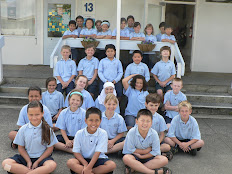
Welcome to Room 13's Learning Journey blog. We are a class of Year 7-9 year olds in Auckland, New Zealand.
RSS

Sunday, September 12, 2010

Working with an expert landscaper

    Mrs Yeoman is the landscaper that came to work with Room 13. She used to be a teacher but now   she designs and plants gardens. She loves working on schools and kindergartens.
Mrs Yeoman taught us about using bird's eye view when you draw a scale map. We are going to 
 design a plan for the large field here at school. We want to plant native trees to attract native birds. (OH & AS)

   
We learnt that you can only see the top of things when you draw bird's eye view on a plan (AA).

We all practised drawing in bird's eye view. (BR)

When Mrs Yeoman was teaching us she said that North is always at the top of a map. North is at the top, South is opposite, West is left and East is to the right. We found out that Gossamer Drive runs north south. The side of the field near the recycling bins is north and the side near the pool is the south side. (AM)
It was hard drawing in bird's eye view because we didn't know the rules before for drawing this way (YS & SL)


Mrs Yeoman showed us her plan for the Orakei Kindergarten. You can see how she was inspired by Maori designs for her design. Her plan shows trees drawn in bird's eye view as if you were looking down like a bird flying over.(BV & SM)


A scale plan that shows where the plants will be planted (J A-A)

Tuesday, August 31, 2010

About Our Worm Farm: Hand Towels For The Worms.

We collect hand towels that have been used.
At our school we get the hand towels for our worm farm from the staffroom toilets and also from the childrens toilet area too.

We have to clean the buckets after the food scraps have gone into the worm farm because the buckets will get dirty. Using scraping brushes and a small bit of water helps.


When you do this you have to make sure that the bucket has NO plastic, yogurt pots or any other things that worms can't eat. You have to take these things out first. After that tip the food in, spreading it out so each section has the same amount of food.

We also keep the area around the worm farm tidy.

Friday, August 27, 2010

New Composting


Yay! we have another composting bottle in room 13. I made this composting bottle last Sunday. I feel very proud of my composting because I can watch everything break down each previous day. It encourages me to find out more about what happens when food is left to rot. This is good for my learning because I can learn lots. Please don't say "oho" or "that's disgusting!" because compost is very good for your garden. Worms are also good for your garden.

The cup shows the liquid that comes out when the organic material breaks down.

Cabbage Plants results.

These are this weeks results.

For the plant that got worm tea we had: 7.5cm long leaves and 14 leaves. The results for the No Worm Tea plant was: 6cm long leaves and it had 14 leaves. For the worm tea plant, we are putting worm tea on it once a week. We have to put on one quarter of a cup of worm tea mixed with water. We can see a small difference already! Wait for next weeks results.....

Sunday, August 22, 2010

Week 5 and our Persuasive Argument Writing

Wow, Room 13... I have looking more closely at your planning for your speeches, and your opening introductions, and I am really impressed by the way you are: 

* thinking about your purpose and audience - to talk about an area   
   of sustainability that you care about deeply  

 * appealing to your audience's feelings through sharing your own  

 * researching in books, the Internet, and doing surveys around 
   school  to collect information, facts or examples to support what 
   you are saying. (I love the rubbish survey, and the Values survey 
   in a Junior room- this is excellent data to support your argument 
   and it is really connected to your audience)


    There is a real variety of topics- sustaining our ...
    * (local/personal)- health, school playground environment, 
       friendships, cultures /cultural awareness, zero waste
    * (NZ)- marine mammals
    * (Global)- forests (deforestation) 

       I can't wait to hear them all. Keep up the great thinking and keep 
       questioning.

    Friday, August 20, 2010

    Our Scientific Experiment.

    20/ 08/ 10


    This is a picture of Room 13's experiment. On the left you can see a pot with a bit of plastic sticking out which says ''Worm Tea'' and on the right you can see the words ''No Worm Tea.'' We are showing you how worm tea works. At our school we have our very own Worm Farm with hundreds and thousands of Tiger Worms.
    This plant is called the Chinese Cabbage and we are going to use the worm tea on one of the plants to prove it really works. We predict that the plant that gets the worm tea will grow bigger and more quickly. We are going to measure and count the leaves each week. Watch this blog for next weeks results.

    GA

    Tuesday, August 17, 2010

    Tree Planting

    Down at the stream that runs through Elm Park reserve, the year 6 enrichment from Elm park school and some Y4 students have been planting 260 trees on the side of the stream. One of the trees is called Kahikatea; it is one of the tallest native trees. We are planting native trees because at Elm park school we want more native birds, insects and trees. The Park and our EPS trees will merge together to make a great habitat for birds one day. I feel happy that we are helping the enviroment. HG